What Are LSI Keywords and Why They (DONT) Matter? BEGINNERS GUIDE
Vinayak SP
3/03/2026
Latent Semantic Indexing Keywords popularly known as LSI keywords is not a new term for SEO experts and experienced bloggers. However, for those who are new to blogging fraternity, this may seem like an alien topic. But I must say you will able to boost your SEO strategy by integrating Latent Semantic Indexing Keywords. Enhance content relevance and search engine visibility very fast.
LSI Keywords —
In this guide, I will provide a detailed explanation of LSI keywords, their importance in modern semantic SEO, and how to find LSI keywords for your blog posts. We'll also explore how entity-based SEO and topical authority have evolved the concept of semantic keywords in today's AI-driven search landscape.
LSI (Latent Semantic Indexing) keywords play a crucial role in boosting your search engine rankings and relevancy. They are related terms and phrases that improves the context and comprehensiveness of your content. In the age of Google BERT and AI-powered search, understanding semantic relationships between words has become more critical than ever.
By adding LSI keywords in your write ups, you can optimize your blog posts content for better visibility and organic traffic. Combined with keyword clustering and NLP optimization, you can build topical authority that search engines love.
I will share effective methods to grab LSI keywords and use them effectively in your writing to attract search engine algorithms and engage your readers. We'll also cover how SEO copywriting techniques can enhance your semantic keyword strategy.
LSI Keywords
Latent Semantic Indexing (LSI) is a mathematical technique that identifies patterns in the relationship between words contained in an unstructured collection of text. Keywords found using this technique are called Latent Semantic Indexing Keywords or LSI Keywords.
Too technical and confusing? Ok, let me simplify it for you.
LSI keywords are keywords which are "semantically" related or in simpler terms "closely" related to your main keyword. For example, the LSI Keyword for "SEO" would be "On Page SEO Tips" or "On page Search Engine Optimization Tips"
Sounds more like a Long Tail Keyword? Well, it is not. Let us understand the difference between LSI Keywords and Long Tail Keywords
LSI (Latent Semantic Indexing) keywords are conceptually related terms and phrases that search engines use to understand the context, topic, and depth of web content, rather than relying solely on exact-match keywords. They help Google determine page relevance, improve ranking potential for synonyms/related queries, and prevent keyword stuffing by offering natural, semantic variations.
In modern semantic search optimization, LSI keywords have evolved into broader entity-based SEO strategies. Search engines now use natural language processing (NLP) to understand user intent and context, making semantic relationships more important than ever.
Key Aspects of LSI Keywords
Contextual Relevance:
They provide context to search engines (e.g., if the main topic is "Apple," LSI keywords like "iPhone" vs. "fruit" tell Google if the page is about technology or food). Not Just Synonyms: LSI keywords are not just synonyms; they are terms that frequently appear alongside the primary keyword in natural language. Examples: For "Digital Marketing," LSI keywords might include "SEO," "social media," "content strategy," "ROI," and "analytics".
Why LSI Keywords Matter for SEO
Improved Search Understanding: They help search engines comprehend the depth of your content, allowing your page to rank for the main topic rather than just a single search term.
Higher Rankings: Using LSI keywords helps Google see your content as a comprehensive, authoritative resource.
Avoiding Penalties: By replacing excessive repetitions of the main keyword with relevant LSI terms, you avoid "keyword stuffing" penalties.
Enhanced User Experience (UX): Content becomes more natural, readable, and informative for users, which can increase engagement metrics like time on page.
Broader Traffic Reach: Including related terms allows you to capture long-tail search traffic that you might otherwise miss.
How to Find and Use Them
Google Search: Look at the "Searches related to" section at the bottom of the results page.
Autocompletion: Use Google's autocomplete feature to find related queries.
Tools: Utilize tools like LSIGraph, Ahrefs, or Google Keyword Planner to discover semantic terms.
Placement: Naturally incorporate these terms throughout your content, including headings, subheadings, and meta descriptions.
To rank a blog post at the top of search engines, focus on high-value, relevant content, on-page optimization, and user experience.
What Is the Purpose of LSI Keywords?
The purpose of LSI (Latent Semantic Indexing) keywords is to boost the relevance and context of content for search engines. LSI keywords help search engines understand the topic and intent of a webpage. By adding LSI keywords naturally into your content, you can boost SEO rankings, increase organic traffic, and provide a better user experience. LSI keywords also help in building a strong and authoritative website by covering various related terms and concepts.
Google uses LSI keywords to find the relevance and quality of your posts. So by applying these words with your content, you can easily boosts its chances of getting search ranking higher. In the context of Google's MUM update and AI search algorithms, semantic keywords help build topical authority that improves your visibility across related queries.
Modern SEO requires understanding search intent optimization and creating comprehensive content that covers entire topics, not just individual keywords. This is where on-page SEO optimization meets semantic relevance.
Difference Between LSI Keywords And Long Tail Keywords
LSI keywords may seem similar to Long Tail Keywords; however, they are not the same.
For a given primary keyword, its LSI keywords are a hybrid of Long Tail Keywords, its synonyms, and even acronyms.
For example, if your primary keyword is "Laptop", your LSI keyword can either be "Best Laptop in India" or "Best Notebook in the USA." Please note that the former keyword is actually a Long Tail Keyword of our primary keyword, while the latter replaces "Laptop" with its synonym "Notebook" to form a totally different keyword.
From the above example, we can say that for a given keyword, its Long Tail Keyword is its LSI Keyword; however, vice versa is not always true.
A Point should be noted that;
A Long Tail Keyword is the same as an LSI Keyword; however, vice versa is not always true.
Use Of LSI Keywords By Search Engines
In yesteryears, Google used to display search results by matching the exact keywords. However, over the years, Google's Algorithm has evolved to be smarter. You must aware about latest Google search algorithms as well to know how search engine working and evolving regularily.
Google no longer looks for exact keywords. Rather it tries to decipher the intent behind the search and shows the results accordingly. This shift toward semantic search and entity recognition means that keyword clustering and topic clusters have become essential SEO strategies.
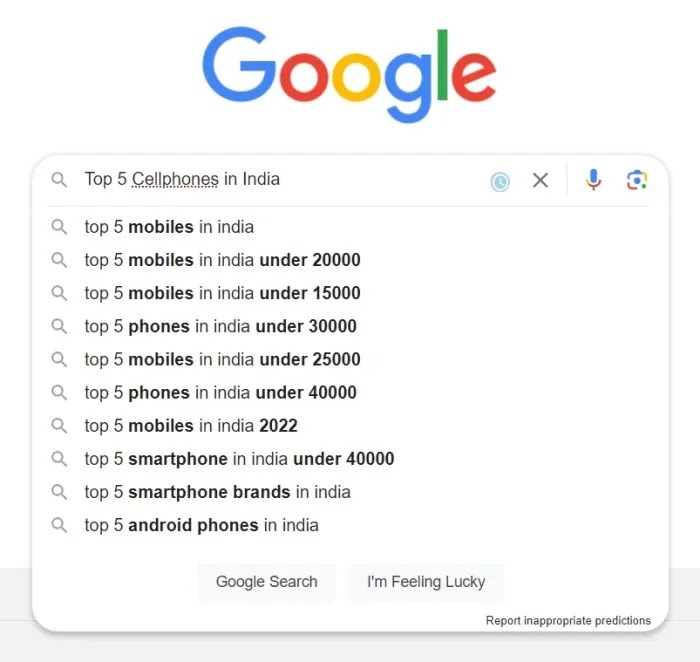
For ease of understanding, let me explain to you with an example how Google uses related keywords for displaying better search results. We will try finding "Top 5 Cellphones in India" and see what Google gives us back.
Searching Top 5 Cellphones in India
As you can see in the screenshot, neither of the results contain the keyword "Cellphone" as this term is seldom used in India. Rather, Google searched for related words which are "Mobile Phones" and "Smartphones."
Also to be noted, I searched for the term "Top 5", but Google was also looking for the keyword "Best" as the same has been bolded in both the results.
Let us take another example of the keyword "Iron." Now, we know that when a person says Iron, he may be referring to any of the following
The Iron metal.
Iron mineral which is part of your body.
Electric Iron device.
The verb Iron, which refers to Ironing of clothes
However, depending on your search query, Google tries to decipher the intent of your search to display the right results for you.
Below are the results for the search phrase "How to Iron."
LSI Keywords Intext Example
Event though I never mentioned Ironing Shirt or clothes, Google deciphered the same as the search phrase contains the word "How to." which can only be associated with Ironing of clothes.
Now just check what you get when you search for "Repair an Iron"
As the search phrase contained the word "Repair", Google knew you are referring to Electric Iron and displayed the results accordingly.
This demonstrates how entity SEO works - Google understands the semantic meaning behind queries and matches them to relevant content, even without exact keyword matches. This is why building topical authority through comprehensive, semantically-rich content is crucial for modern SEO.
Importance Of LSI Keywords In SEO?
Now that you know how smart Google's algorithm is, let us come back to the million dollar question: Why Are LSI Keywords important for SEO?
Why Are LSI Keywords important for SEO?
Maintain Optimum Keyword Density We know keyword stuffing is a thing of past and you have to make sure to keep your keyword density in check to avoid Google penalty for over-optimization of keywords. LSI Keywords help you achieve the same. You can use a combination of semantically related keywords to keep your keyword density under check.
Reduce Bounce Rates Suppose you have a website which talks about benefits of Apple; the fruit. What would happen if Google ranks you for the keyword Apple iPhone? It's very much natural that people who visit your website will leave your website immediately, increasing your bounce rate. This is neither good for you nor for your reader. By using LSI keywords you can prevent this situation.
Increase Organic Traffic By using LSI keywords, you are targeting more keywords which will make sure you appear in Google search results more often.
Target Wider Audience Some keywords like "Cellphones" are Geography specific. By using the keyword "Mobile Phone" along with it, you can target much wider audience.
Additional Benefits in Modern SEO:
AI Search Visibility: With the rise of AI-powered search engines and ChatGPT search, semantic keywords help your content get cited in AI-generated answers.
Voice Search Optimization: Natural language queries rely on semantic understanding, making LSI keywords crucial for voice search SEO.
Featured Snippets: Comprehensive content with semantic relevance has better chances of appearing in position zero results.
Content Clustering: LSI keywords help build topic clusters that establish your site as an authority in your niche.
How To Find LSI Keywords
To find LSI Keyword, you first need to find a primary keyword using tools like Keyword Planner, Ubersuggest, and SEMRush. Once you have your primary keyword, you can use below methods to find LSI Keywords.
1. Google Related Search
This is the traditional method of finding LSI Keywords. You just need to search for your primary keyword on Google and scroll down to the bottom of the search results. You will see the related search queries as shown in screenshots shown above
As you can also check, if you search for "How to book train tickets" then Google also suggest a keyword "How to book railway tickets"
Google does not show the monthly volume and CPC for each keyword beside the query. However, you can get it using Keywords Everywhere extension for your browser.
2. Google Keyword Planner
Google Keyword Planner is the most flexible yet underrated keyword research tool you can ever get. It helps you to find different types of keywords with small tweaks.
I've already discussed how to use Google Keyword Planner in my guide about Long Tail Keywords. To find LSI Keywords, there is just one small change. While searching for Keyword Ideas, you must make sure to keep the option "Only Show Closely Related Ideas" unchecked.
Keyword targeted traffic can improve overall SEO by integrating keywords relevant to your product or service in website to improve visibility in search engines.
This will make sure Google Keyword Planner displays broader terms. Sorting out the relevant terms from the suggested keywords is a bit tedious but it can give you some unexplored keywords. But, I recommend using this method only if you are unable to find low competition keywords using other methods.
3. LSI Graph
LSI Graph is a special tool designed by SEOPressor for finding LSI Keywords. This is free to use tool which is mostly accurate with the suggestions.
It is extremely simple to use this tool. You just have to enter your primary keyword in the search box and click on "Generate" and it will give out a list of LSI keywords.
4. SEOPressor WordPress Plugin
SEOPressor is basically an On Page SEO Analysis plugin that checks your web page for various On page SEO Optimization Factors. Suggesting LSI keywords is just one of its many features.
It lets you enter up to 3 main keywords and suggests you LSI keywords based on these 3 keywords.
It also checks your article for Keyword Density and suggests replacing a particular keyword with a related keyword to keep the Keyword Density under check.
5. AI-Powered Semantic SEO Tools
Modern semantic SEO tools like Clearscope, SurferSEO, and MarketMuse use natural language processing to analyze top-ranking content and suggest semantically related terms. These tools help you create comprehensive content that covers entire topics, not just individual keywords.
SE Ranking's Content Editor and similar platforms analyze SERP content to determine how many words, headings, and semantic terms your article should include. They provide content optimization recommendations based on competitor analysis and AI-driven insights.
For enterprise-level entity SEO, tools like Schema App help implement structured data and entity linking at scale, making your content machine-readable for AI search engines.
Selecting LSI Keywords
The number of different LSI keywords you can use depends on the length of your article. Longer the article, more keywords you can squeeze in.
While selecting the keywords, most bloggers make the mistake of selecting the ones with higher search volume. I personally prefer using a combination of high volume keywords and some low volume keywords with an extremely low competition.
This method ensures that you start getting traffic to your blog almost immediately and if your bounce rate is low, you SERP will quickly improve for all the keywords you use in your post.
Also, it is very important to choose only the keywords which are 100% related to your article. Using unrelated keywords just because it is popular will result in higher bounce rates.
Placing LSI Keywords
Placing your keywords can be a little tricky. You must know which keywords are important and needs to be given more priority.
Also, the keywords should be used in a natural way. Search engines will not subscribe to your newsletter or use your affiliate links to buy products. Your readers will. And so you must use your keywords in a natural way.
I generally reserve my post title and URLs for a Long Tail Keyword which contains my primary keyword and has low to medium competition with a monthly search volume of at least 200.
For Meta Description, it is recommended to use LSI Keywords containing synonyms of your primary keyword as it can boost your search rankings. So if your primary keyword is "Samsung Mobile phone", your can use keywords like "Best Samsung Smartphone" in your Meta Description.
For your post headings and content, you should only go with LSI keywords that you can place naturally in the text.
Strategic Placement for Maximum Impact:
Title Tags: Include your primary keyword and one strong LSI keyword
Headings (H1, H2, H3): Use LSI keywords to create semantically rich structure
First 100 words: Introduce your main topic with 2-3 related terms
Throughout content: Sprinkle LSI keywords naturally every 200-300 words
Image alt text: Use descriptive, keyword-rich alt tags
Internal links: Use LSI keywords as anchor text to related pages
Conclusion: Reinforce your main topic with semantic variations
Building Topic Clusters:
Modern SEO requires creating content hubs around central topics. Use LSI keywords to build pillar pages and supporting content that establishes your topical authority. This hub and spoke model helps search engines understand the relationships between your content pieces.
Frequently Asked Questions
Please take a moment to read through our FAQ section for quick answers to common questions.
How do I find my LSI keywords?
To find LSI keywords, you can use tools like Google Keyword Planner, LSIGraph, or LSIKeywords web portals. These tools generate related terms and phrases based on your primary keyword, giving you valuable suggestions. You can also use Google's "Searches related to" section at the bottom of search results, or modern AI-powered tools like Clearscope and SurferSEO for semantic analysis.
How do I create an LSI keyword?
You don't create LSI keywords directly. They are naturally occurring terms related to your main keyword. By conducting thorough research and understanding your topic, you can identify relevant LSI keywords to incorporate into your content. Focus on terms that conceptually relate to your primary topic and frequently appear together in natural language.
What is the difference between LSI and semantic keywords?
LSI keywords are conceptually related terms that help search engines understand the context of your content. Semantic keywords, in modern SEO, refer to the broader concept of entity-based optimization where search engines understand meaning, intent, and relationships between concepts. While LSI focuses on co-occurrence patterns, semantic SEO encompasses entity recognition, knowledge graphs, and natural language processing.
How do I target LSI keywords?
To target LSI keywords, incorporate them naturally throughout your content. Use them in headings, subheadings, and within the body of your text. Remember to prioritize readability and provide valuable information to your readers while utilizing LSI keywords effectively. Build topic clusters using these keywords, create comprehensive content that covers related concepts, and use internal linking to establish semantic relationships between your pages.
Are LSI keywords still relevant in 2024?
Yes, the concept of LSI keywords is still relevant, though it has evolved into broader semantic SEO and entity-based optimization. Google's algorithms, including BERT and MUM, use natural language processing to understand context and relationships between words. While the original LSI technology is dated, the practice of using semantically related terms remains crucial for SEO success in the age of AI search.
What is entity-based SEO?
Entity-based SEO is an advanced approach that focuses on optimizing for concepts, people, places, and things (entities) rather than just keywords. Search engines like Google use Knowledge Graphs to understand relationships between entities. This approach involves creating content that clearly defines entities, using structured data markup, building topical authority through comprehensive coverage, and establishing your brand as a recognized entity in your industry.
Bottom Line
LSI Keywords are definitely a very important part of SEO and Keyword Research. They can greatly help you keep your keyword density under check. If used in the correct way, LSI Keywords can boost your search engine rankings and get you a lot of search engine traffic.
In the modern era of AI-powered search and semantic SEO, understanding and implementing LSI keywords has become even more critical. Combined with entity-based optimization, topic clusters, and comprehensive content strategies, LSI keywords help you build topical authority that search engines reward.
I hope after reading this article the concept of LSI keywords is clear to you. Remember that SEO is constantly evolving, and staying updated with the latest trends in semantic search, NLP optimization, and AI search algorithms will keep your content competitive.
Do let us know your views about the article through comments below. And don't forget to check out our guide on how meta tags improve your PageRank for additional SEO insights.
Read Online & Share
Scan this QR code with your phone's camera to instantly open the live version of this article.
If you enjoyed this article, please share it with your friends and help us spread the word.
We are a professional review site that operates like any other website on the internet. We value our readers' trust and are confident in the information we provide. The post may contain some affiliate/referral links, and if you make a purchase through them, we receive referral income as a commission. We are unbiased and do not accept fixed marketing articles or fake reviews. We thoroughly test each product and only give high marks to the very best. We are an independent organization and the opinions/views/thoughts expressed here are our own.
Privacy Policy
All of the ProBlogBooster ideas are free for any type of personal or commercial use. All I ask is to keep the footer links intact which provides due credit to its authors. From time to time, we may use visitors/readers, information for distinct & upcoming, unanticipated uses not earlier disclosed in our privacy notice. If collected data or information practices changed or improved at some time in the future, we would post all the policy changes to our website to notify you of these changes, and we will use for these new purposes only data collected from the time of the policy change forward. If you are concerned about how your information is used, you should check back our website policy pages periodically. For more about this just read out; Privacy Policy
Boost your WhatsApp experience by editing sent messages within 15 minutes, and much more like hiding your "last seen" from specific people, and using "view once" for private media. Find out most essential tips including locking your chats with biometrics, using bold/italics texts for formatting, sharing live location, and creating the chat shortcuts for quick access.